Tag Archives: Holocaust

A sacrifice that continues

Born from the ashes of the Holocaust in Europe, the Jewish nation of Israel declared its independence in 1948.  Those who have died defending it or whose lives have been taken in acts of terror need to be remembered and honored by Jewish people all over the world, not just those living in Israel.  Being that this blog revolves around a book that chronicles the lost souls at a time when there was no organized Jewish army, I feel nothing could be more appropriate than showing respect to those who lost their lives in the name of never allowing it to happen again.  Although this is a video taken a few years back, the air raid siren is what happens all over Israel in honor of those who were lost.


The Importance of Freedom

As Jews all over the world celebrate Shabbat (the Jewish Sabbath), I think back once again to what we commemorated and remembered this week.  It strikes me how the Holocaust reached even further than the 6 million killed.  The basic freedom to practice the religion in any way was stripped from mostly every Jew in Europe.  The lesson to  us all, regardless of what we believe in or practice, is to never take for granted our freedom and to stand up and fight those who would oppress others merely for being what they are and for what they believe in.  We must recognize it happened before in order to prevent it from happening ever again.


Holland’s Experience:Test your knowledge

In a continuous effort to increase Holocaust awareness, I have put together a series of questions regarding what the Dutch community went through during the Nazi-occupation.  The answers are at the bottom of the page.  Comments are welcome and well be posted after moderation.

1-What percentage of Amsterdam was Jewish in 1940?

2-How many Dutch Jews were murdered in the Death camps?

3-What was the name of the concentration camp in Holland set up to accommodate German refugees in the 1930s and later used as a transit center?

4-What was the name of the Death camp where an estimated 34,000 Dutch Jews were murdered?

5-In what concentration camp did Anne Frank die?

These are just 5 questions but they will give an indication of what you know about what Holland experienced during this time.  The more we know, the more we can increase awareness and fight those who try to claim it never happened.  Again, your feedback is welcome.


Answers-10% 2-104,000 3-Westerbork 4-Sobibor 5-Bergen-Belsen


The Life That Was Not Lived

The following  piece written by my father of blessed memory is the Foreword for the book “Jew Face: A story of love and heroism in Nazi-occupied Holland.” It is extremely appropriate for Yom HaShoah (Holocaust Remembrance Day).

FOREWORD
by Rabbi Nardus Groen, of blessed memory

The life that was not lived:

This is the story of two people whose experiences cannot be seen as
separated from one another. At the same time, it includes a multitude of people
whose story will never be told. We therefore consider it a privilege as well as a
duty to share with you some of the 4,380 days of our being on this earth.
Existence is more or less a state of exposure. Life, on the other hand,
is a matter of faith. If there was such a thing, my choice would be for
something in between. Some attributes may be applied to it, and others
may not fit the shoe.

We may in the course of it meet people who, for whatever it’s worth,
may be portrayed as heroes, while others are cowards, pacifists, or activists.
They are all the products of mankind. For them, there will always be a
place under the sun (with the exception of the traitor). But being as we are
a homogenous society, no one can ever be left out. And as it is by the very
inclination of the human race, the dark shadow of the wicked will play an
overpowering role in leaving behind the marks in the way of scars brought
upon them by society.

If the worst could ever be turned into good, the only lesson to be learned
of that is, never ever forget. For in the past lay the present, and in the present
the future. Without that, we will be repeating our mistakes and shortcomings,
and as a result the world will not be the place it was created to be.

In order to live, you still have to be able to somehow believe in the
goodness of mankind. In that light, we will start with our first words to
describe that which has been and never should have been.


Remembering The Holocaust-A Personal Perspective

Being the child of Holocaust survivors I have been exposed to the reality of what took place from the time of my earliest memories.  Naturally my understanding of the events developed as I grew older, but from a young age the one thing I knew was that my parents went through something not everyone else’s parents went through.  I never knew my grandparents.  My mother’s mother passed away many years before the war, but her father and my father’s mother and father were all killed in Auschwitz.

As I grew up I went through this stage where I thought that my parents had a pretty easy go of it in the war.  After all, they didn’t have numbers on their arms and my mother was never even arrested by the Nazis.  How bad could it have been?  That stage did not last long as I soon began to gather a more educated understanding of my parents’ experience.

I believe it started with me trying to imagine the relatives I never knew.  I would think of my father’s parents.  Listening to the stories my father would tell, I would always feel a special connection to his father.  One I could not explain rationally or logically.  I just felt a somewhat mystical bond.  His mother would seem to me like a woman with a quiet demeanor but strong willed character.  My father would always speak with them with nothing but respect which inevitably would translate to how I and I presume the rest of my siblings would perceive them.

I would then try to imagine my mother’s father.  He always seemed like the man everyone wanted to meet at least once.  He was an athlete, outgoing, successful in business, while being somewhat mysterious.  At least that would be how it looked through my young eyes.  And then I would think of my mother’s brother and all I would see was a sweet, talented, and gentle young man who should have had a chance to live in an easier time.  I knew my mother loved them both deeply and that remembering them was more emotional than almost anything else.

I would imagine all of them and try to picture them.   How they lived, how they spoke, how they might have spoken to me.  At one point however I realized that when imagining them my imagination never left Amsterdam.  I could not imagine them being picked up in a raid and stuffed on a train to ultimately wind up in Auschwitz.  And I most certainly could not imagine them being killed in the gas chambers.  I could not imagine any of this.  It was just too difficult.  And I never even knew them.

It is hard to conceive the horrors experienced by the murdered victims of Nazi Germany.  Of the 6 million Jews who were murdered during this time, many were tortured, beaten, raped, used for experimentation, and made to suffer in ways that a normal mind cannot even begin to conceive.  And for those who experienced this level of suffering and survived, to make an attempt to comprehend what they felt would have to be impossible.

True, my parents did not have those specific experiences.  What they had to endure was running from an enemy that would certainly kill them, hiding in whatever location they could find regardless of the conditions, being so deprived of food that fresh bread and butter seemed like a luxury, and finding out that almost everyone they knew, loved, played with, studied with and laughed with, was gone.  Taken away forever.  Earlier today I closed my eyes and tried to imagine being in a New York where 75% of the Jewish community was gone and in a world where the majority of my family was suddenly dead.  I could not do it.  It was just too difficult emotionally.   For my parents and for so many like them, they did not have the luxury of opening their eyes and going back to a better reality.  The reality was brutal and would never ever be altered.  All it could be was remembered.

The Holocaust the Jewish people suffered through was of such an enormous magnitude that the people who went through these horrors on whatever level they did are called survivors, when in fact they too were victims.

There are various factors that have contributed to the survival of the Jewish people since the horrors of Nazi Germany.  A case can be made for any one of many reasons being most important.  Some would say it is the existence of the State of Israel, while others might say the commitment of the Ultra-Orthodox or the traditional Jew, while others may say it is the activist who will fight either physically or verbally in defense of the Jewish people.   One thing is certain.  It is not because of the person who does nothing.  Until recently I considered myself one who did nothing.  Although I have always been proud to be a Jew, I’ve never felt like I did enough.  On this eve of Yom HaShoah, I feel a responsibility like never before to be a voice that reminds people of what happened and to fight those with the gall to claim it never did.

It may be too painful for me to imagine, but it is even more painful to my soul to allow myself to ever forget.


Fighting A Cancer

As a son of Holocaust survivors it would be obvious why remembering what happened to the Jewish people during the reign of the Nazis would be of importance and significance to me.  What I am going to attempt to do in this post is briefly show why it should be important to everyone.

There is a cancer in the world today.  This cancer is the movement known as Holocaust denial.  I am Jewish, and on this site and the book I have written there is a focus on the horrors that befell the Jewish people.  I make no apologies for where I focus my efforts.  However, I also recognize that although 6 million is a staggering number, the Jewish people are not alone in their suffering.  Whether it was African slave trading, the Khmer Rouge’s Cambodian genocide,  the policy of “ethnic cleansing” in Bosnia, the genocides in Cyprus, Rwanda, and Darfur,  our world has been tarnished by numerous examples of mass persecution and genocide.  I am making no attempt to compare suffering, and I am not missing out on mentioning any group intentionally.  All I have done is take some notable examples of mass persecution and genocide in history to make an important point.

Cancer usually begins in one part of the body.  The cancer of Holocaust denial, a cause that is meant to belittle the suffering of the Jewish people during Nazi occupation in Europe and challenge its severity and magnitude, does not only threaten the Jewish people, one part of the world’s body, it threatens all decent people, and all healthy parts of the world body.

How can we say “NEVER AGAIN”, if we have to fight those who want to challenge that it happened in the first place.  Ignore a cancer and it spreads.  And when it spreads it poisons the entire body.


The Writing of Jew Face

How does one write a book about one of the most horrific times in history? How does one write a book about his or her parents especially when one has been gone for close to five years? And how does someone write about various people who exemplified courage, righteousness, kindness, and self sacrifice?

On so many levels writing the book “Jew Face” has been one of the most humbling experiences of my life.  As much as I might try to feel what people who lived through the Nazi occupation and Holocaust in Europe felt, there is no way anyone who did not go through this time could actually capture this feeling.  On an intellectual and compassionate level, anyone who is decent and thoughtful can understand how awful it was, but to write about it and to attempt to immerse oneself in it, is at the very least difficult, at most impossible.  I made every attempt to do this while realizing all I could really do was convey my respect and honor to the memories of those lost and the pain and suffering of those who survived.

In writing about my parents I was confronted with a challenge.  Do I search out their flaws and develop those areas of their character, or do I eliminate that dimension and focus on the qualities that made them special in this story?  I chose the second option for two reasons.  First of all my stories were based on their personal accounts and therefore I chose to portray those accounts the way that they were conveyed to me.  I as someone who heard these stories my entire life, still find them fascinating.  This is because of the positive content, not because of an unnecessary objectivity of the character of those who told the stories.  The book is about their stories, not about the complexities of their respective characters.  As a son I remembered only the greatness of my father and recognize the greatness of my mother with the same passion.

The second reason I went this direction is because the evil in this book is so clearly defined by being either a Nazi or a Nazi sympathizer that I chose not to focus on the imperfections of the decent individual.  In this book there is a clearly defined good and evil.  There are very few shades of grey.

And finally, how did I manage to write about people who exemplified such incredible behavior? By constantly feeling humble, feeling honored to write about them, and by trying to learn to be a better man while writing about better men and women than I could ever be.  They are already immortalized by the worlds that have come from them.  All I did was attempt to make it possible for as many people as possible to learn about this small handful of very special people.


A message of freedom and remembrance

Passover begins tonight at sundown, and as Jewish people all over the world prepare to celebrate being freed from slavery and oppression, I can’t help but feel an added responsibility to use this forum to draw a connection to what took place in Europe between 1933-1945.

It is difficult to get a clear understanding of what took place in Egypt since it happened so long ago, but what is clear was that the goal was to deprive all Jews of their freedom and ultimately destroy the very existence of the Jewish people.

Passover is a time of celebration.  As a people we sit around the Seder and celebrate our freedom and our liberation from the oppressor whose sole purpose was to wipe us off the face of the earth.  The similarity between the purpose of the Pharaoh and that of Hitler is almost eerily similar.  Yet when we discuss the story of Passover we do so with a levity and comfort we do not have when discussing the Holocaust.  The reasons are fairly obvious.  The magnitude of the destruction done by Nazi Germany is clearly greater.  Six million is a staggering, incomprehensible number.  And the visual evidence and personal testimonials make it so real to all of us that it becomes more abhorrent and more painful to acknowledge.  Even with this being so, the suffering of one person being forced to do slave labor, or the significance of the murder of one individual is just as important and meaningful when they are one of tens or hundreds of thousands as when they are one of six million.  The value of their life is the same.  Subsequently the value of a people being freed from either oppressor is just as significant and liberating.

It has always been my personal feeling that regardless of what part of history inspires us on a day we celebrate freedom, we must use this day to not only celebrate it, but appreciate it as well.  For if there is one thing we must learn from the more recent suffering, is that we should never take our freedom and even survival for granted.  And the lesson we learn from sitting down and having a Seder where we tell the story of Passover is that we must never forget what happened, and that the best way to accomplish this is to tell the story.

I wish all of my fellow Jews a Happy Passover, and a Happy Easter to all of you who will be celebrating  this Sunday.


Never Forget

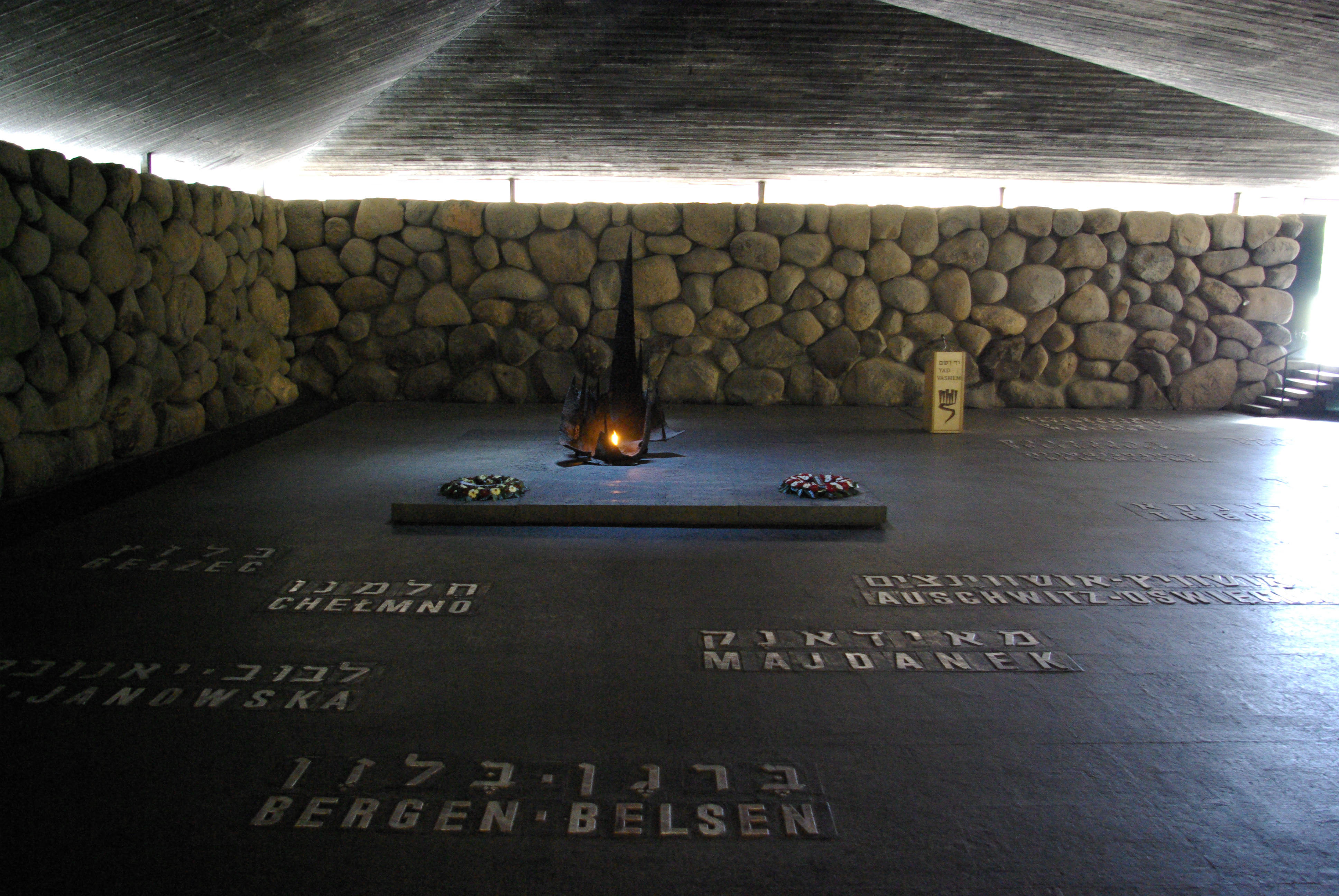
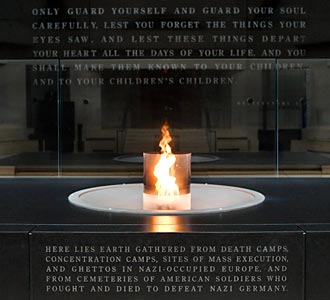
The Hall of Remembrance at Yad Vashem, the official Holocaust Memorial Museum in Jerusalem, Israel.


Esnoga-Portuguese Synagogue of Amsterdam

The Esnoga, the famous Portuguese Synagogue of Amsterdam, holding a service for survivors of the Holocaust on May 9, 1945.