Category Archives: Uncategorized

A Post Sandy Update: An Old Friend’s Story and a Trip to Brooklyn

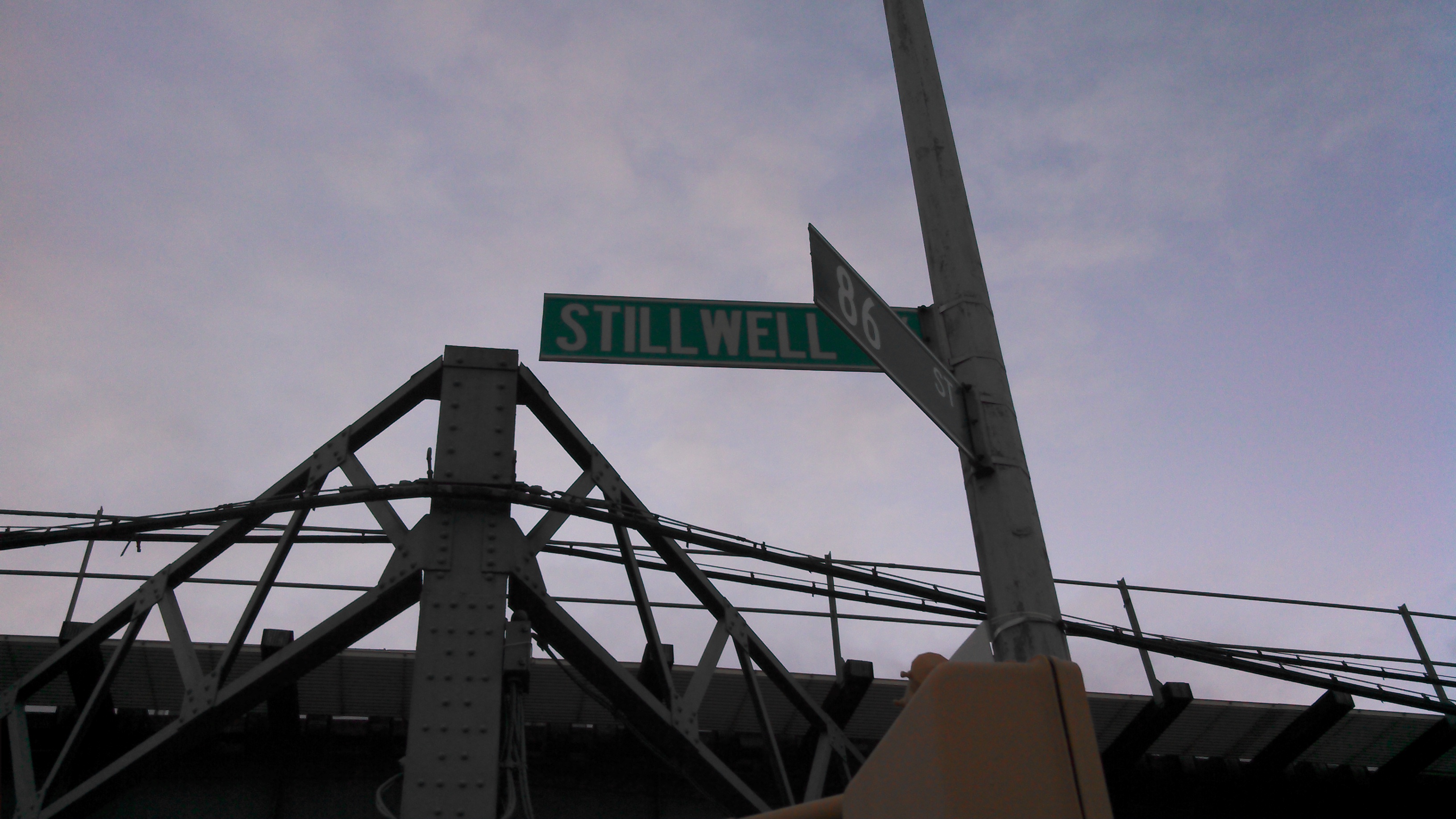
Today in taking the D train into Brooklyn I hoped to either find a place where I could either volunteer to help or end up at Coney Island to see some of the damage.  Instead what I learned today is that the usual rules of travel do not apply.  Obviously there are still service changes on the trains so I knew that I was dealing with that issue, but when it comes to getting somewhere in New York I tend to have a confidence bordering on arrogance.  I believe that I will figure it out as I travel and that no significant planning is necessary.  Under normal circumstances I am correct.  Today I was not.  So when I got off the train at Bay Parkway to go to Coney Island, instead of my walk getting me to somewhere where I could do some good, all it did was provide me with about 2 miles worth of walking.  Sure I was in the general vicinity of one of the hardest hit spots, and I did see cleanups in progress, but had it not been for my chance encounter on Stillwell & 86th Street, my trip would have been a waste of time.

While passing a gas station on this particular corner I thought I heard someone shout out “Dave!”  There are some occasions when you hear your name called that your gut reaction is that it is not you the person is calling.  Nevertheless you always look because IT IS your name you are hearing.  This was the case for me today.  As it would happen, getting out of one of the cars waiting in line for gas was an old friend named Desiree.  I worked with her over 5 years ago.  Desiree’s memory was so eerily good she remembered things about my life I had already forgotten.  It was 4PM and Desiree, who was celebrating her birthday, had been in line for gas since 3:30AM.  This was a gas station she frequents, but told me that the man working there who sees her normally was anything but nice today.  There were already problems there earlier that had required police involvement and this man’s patience was wearing thin.  I admired Desiree’s persistence and diligence but when I left her I was fairly certain she was not going to be getting any gas today.

Desiree lives a few blocks from Coney Island.  She was without power until yesterday.  She actually was surrounded by blocks that had powers days earlier, but for some reason it took longer for hers to be restored.  The thing she told me that was fascinating was what happened during the peak of the storm.  As the water was rising it was closing in on her from 2 directions.  It was clearly rising fast and the feeling of it closing in on here scared her to the point of paralysis.  I have not seen Desiree in over 5 years, but one of the things I remember about her, is that she is tough.  For this to scare her to this extent just puts emphasis on what I’ve heard from others who experienced the storm surge.  It looked like Titanic.

I have heard many things said this past week that were frightening and disturbing.  One of the most poignant statements was from my brother Marcel who reminded me that with all the devastation, this was only a Category 1 storm.  The thought of what might have happened if it was a Category 3 storm or stronger is somewhat terrifying.  However, what Desiree told me today, at least for me, was the most frightening thing I had heard.  From what she saw firsthand, if the storm surge had lasted about another 15 minutes, the devastation we’ve seen this past week would have been significantly more widespread.

There was some comic relief provided by the people who seemed to get aggravated at Desiree for not having the answers to their gasoline related questions.  It was even funnier when they asked me because I don’t even own a car, but they’d have no way of knowing that.

So the cleanup continues, it appears as though Long Island is still very much in the dark, and it is getting very cold in New York.  Let’s hope and pray the worst hit find a way to stay warm.  And for those of you who are wondering, the crane looks secured but my street is still closed.  Stay tuned and thanks for reading.


A Post Sandy Update: Firsthand Accounts from Coney Island and Staten Island (With pictures)

Today I had the benefit of two firsthand accounts.  One is from a friend in Coney Island and is accompanied by pictures; while the other is from someone I met from Staten Island and may later be accompanied by pictures.  Having heard that today would be the day they would secure the crane hanging over my head in Midtown, I did not venture out till mid-afternoon.  Yes I’ve decided to declare that it was hanging directly over my head.  I’m not saying this based on any real evidence, but rather for the mild degree of drama that the statement carries with it, and since after tomorrow the crane may no longer be a story at all, I choose to give it one last moment in the forefront.

Today I wanted to go to Brooklyn.  I knew it would be difficult to get anywhere close to the spots where anything happened, but even by riding the shuttle bus I would be experiencing an inconvenience, albeit a mild one, for Brooklyn residents.  I took the train to 34th Street and 6th Avenue where I learned that the shuttle bus to Brooklyn was leaving from 34th Street and Lexington Avenue.  I walked to the shuttle bus and decided to take a ride and see where it would lead me.

Earlier in the day I had chatted online with a Facebook friend from Coney Island named Yelena.  I asked Yelena to read my piece from yesterday since I wanted to know her perspective of the events in Coney Island during these trying days.  The following is most of what she shared with me.

The night of the hurricane the alarm sirens were going off all the time. When I got out Tuesday afternoon, many cars were looted. I took many pictures but I can’t post them to my Facebook page because I only have very limited access to the Internet on my phone. If you send me your email address, I’ll email them to you.  (Click here for Yelena’s pictures).

The poor business owners on Brighton beach started to clean their stores on Tuesday and from what I have heard they had to stay there all the time to protect them from looters. On Wednesday the police sent 100 more policemen to the Brighton beach area to prevent looting. I think one liquor store on Neptune Avenue was looted right in the midst of the hurricane.

What I really find interesting is that I haven’t seen any news crews anywhere. This area has never been closed for access. People could come to us Tuesday morning with no problem. Many residents couldn’t get out, on the other hand, because their buildings, cars were flooded and the trains weren’t in service.

Thank you for offering your help. We pretty much don’t need anything besides hot water, the heating and the Internet. Our land line is also dead. I was able to get to Manhattan on Thursday and did some grocery shopping.

However, there are many older people who live closer to the water. They still have no electricity, no heating. Many have no running water at all. They can’t get out and I don’t know if anybody is doing anything to help them. Many of them won’t even be able to call for help because land telephone lines went dead and the cell phones need to be recharged.

Yelena’s words motivated me towards Brooklyn however, if there was a way to Coney Island today, I never found it.  Maybe it would have required better planning or maybe it just wasn’t possible.  I got as far as Atlantic Terminal (where I did get to see the Barclay Center for the first time).  I was on the shuttle bus at 4PM when an announcement came out saying that the shuttle buses would be suspended due to service being restored on subway lines to Brooklyn as of 3:30.  I hoped that the subway would take me deeper into Brooklyn, but alas it was not so.  I was headed back into Manhattan.

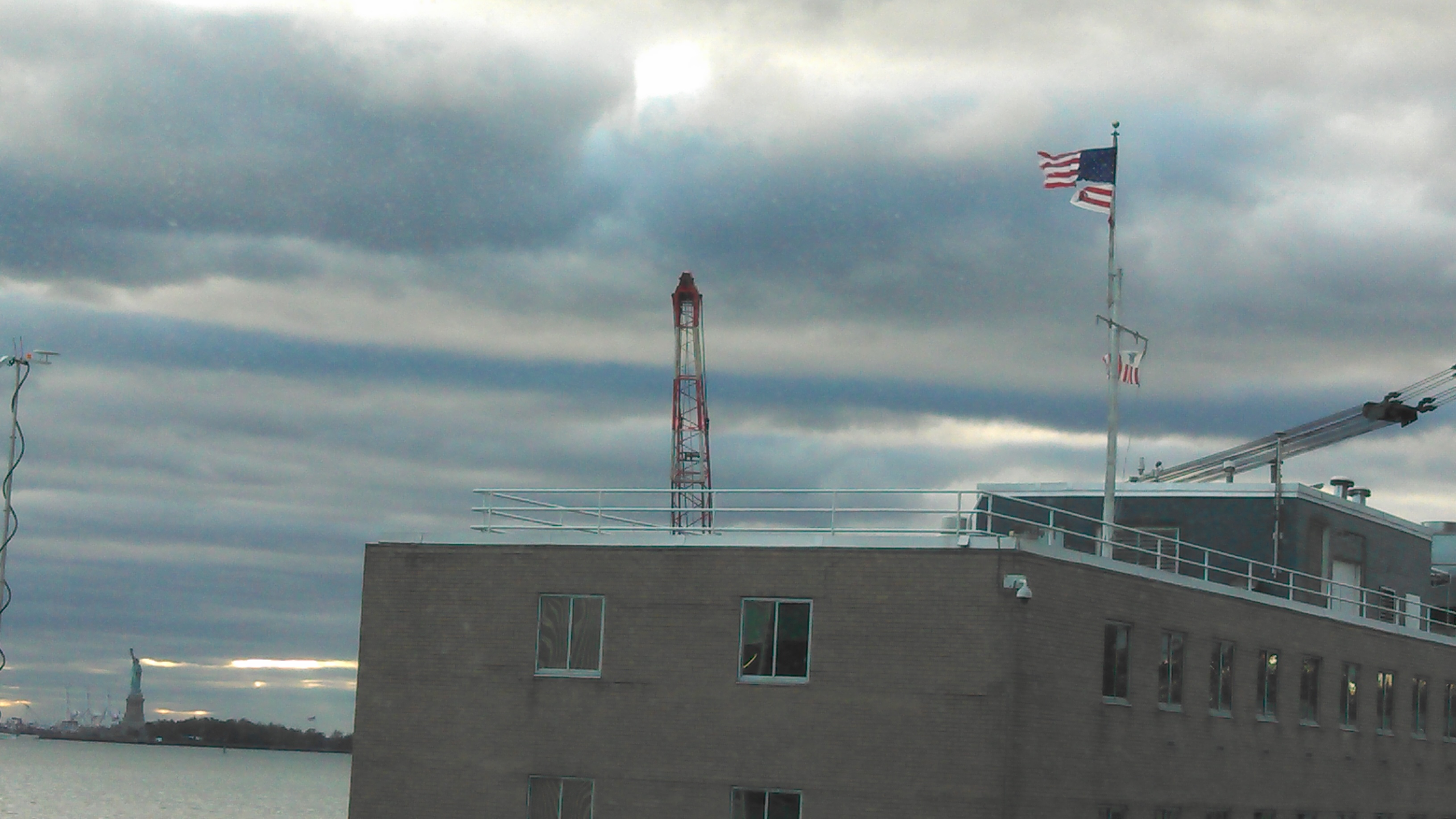
I then decided to get off the subway in downtown Manhattan.  I found myself at the Bowling Green station of the 4 & 5 train and a few minutes away from the Staten Island ferry terminal.  I went into the terminal, considered riding to Staten Island, but chose not to since I had no plan or specific place to go to.  I stayed in the terminal for a few minutes from where I took the picture you see at the top of this post.  It is a shredded American flag, apparently from the storm, with the Statue of Liberty on the left.

I left the terminal moments before a ferry arrived and managed to strike up conversation with a woman walking uptown as I was.  She was pushing her young baby in a stroller, and told me she had just come from Staten Island.

She told me that going on right now in Staten Island, not during the storm, not yesterday, but right now, was a shootout and stabbings over gasoline.  She said it was a crazy scene and it had of course scared her.  She spoke of trees that had fallen in the middle of streets blocking a number of homes at once.  She said that her power had been restored, but then told me something I had not heard till now.  They had power on Tuesday, but then there was a fire in a Con Edison plant in Queens on Tuesday night, causing them to shut down power in her area again on Wednesday.  Just as she said this a Con Edison worker passed by and in a tongue-in-cheek way asked, “What about Con Ed?”  To which she replied, a little less tongue-in-cheek and without hesitation, “you suck”.  She too indicated she would be sending me some pictures to post.  If they come in I will make them available.

I then went home and found out that the piece of the crane that had been hanging over my head was more than likely secure and that my street might be opening as early as tomorrow.  It’s a good thing.  I’m getting tired of carrying around my Verizon bill.  There’s another storm possibly in the forecast for Wednesday.  Let’s hope significant actions are taken by then to help the people who need it the most.


A Post Sandy Update: Coney Island, Looting, and The Dark Night

So today I decided to look for the story.  Naturally with all the events taking place there were stories to be found just by following my somewhat normal routine, but the most interesting information was definitely a result of putting myself in the right place around the right people.  Time in these situations is not as important, except for the fact that it would have to be nighttime.

What I suspect will happen as time goes on, is that for most people life will almost entirely go back to normal.  The people who we will still be hearing about in the months to come will be those from the most severely hit places like Staten Island, Long Beach, and of course the Jersey Shore.  In some ways today was a taste of that.  Of course the commute was slow and the stories were there, but the real seriousness of the storm didn’t hit me today till I got to my office and saw my coworker with a suitcase at her desk.  I did not catch the whole story, but it appeared as though she was not even sure where she was going.  She just knew she was not going home to Long Beach and at one point appeared to be overwhelmed with emotion as she said that she just wanted to sleep in her bed.  It makes me thank God a little more as I sit here writing this while sitting on mine.

I chatted on Facebook with a friend from Staten Island who told me that the situation there was so bad that they were not letting anyone in or out of the worst areas and that they were using an ice skating rink to bring in dead bodies.  All indications are that the death toll from that area has been severely downplayed.  I will get more into that later in this piece.

On the ride home I saw the news that the New York City Marathon had been cancelled.  This news pleased me for a few reasons.  Although I understood the reasons for initially not cancelling it, cancelling it now sent the message that the situation is being watched so closely and that officials are so aware of the needs that they are not afraid to change their minds.  Good leadership sometimes requires flexibility, and in these trying times good leadership is as critical as it has been in some time.  The other message it sends is to those who feel, myself not included, that Mayor Bloomberg is dictatorial, is that he is indeed not and is willing to listen to the opinions of others.  That too, in my opinion, will be a critical factor in the city’s recovery.

Hours earlier I had made a decision.  When my train would arrive at Penn Station, which was now packed with people waiting for the LIRR’s limited trains, instead of taking the subway uptown, I would walk downtown.  I had to see the dark Manhattan.  At first I walked down 7th Avenue.  Although the stretch until 14th Street was not without power, there was a dark feeling to it, almost as if the street lights were on a lower intensity.  It was hard for me to figure out what it was since I am normally not in this neighborhood at night anyway so I had no way of knowing if this was normal or not.  Around 19th Street I turned up to 8th Avenue because I wanted to see the building that had been partially destroyed, but either it had been repaired already or my memory failed me and it was not on 8th Avenue between 14th-18th Street.

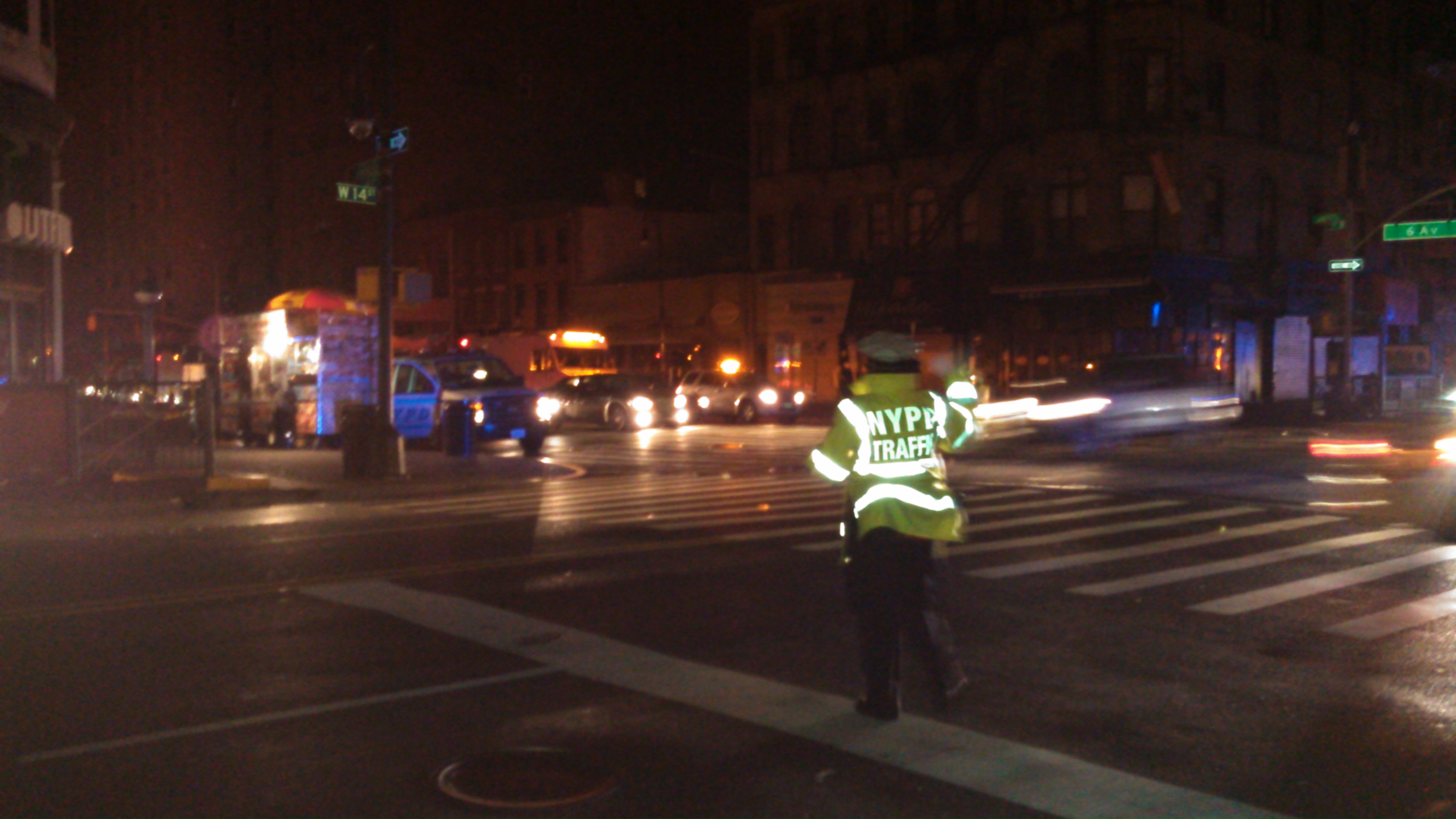
I arrived at 14th Street to one of the oddest sights I have ever seen in New York City.  The northern side of 14th Street had power, the south side was dark.  It was so dark south of 14th street that the people walking further downtown were just disappearing into the darkness in a very eerie way.  The police were directing traffic with flares and whistles.  It almost felt like I had been transported in time.  I’m not sure when, but for some reason this did not feel like 2012.

I then decided to walk east.  For those of you who do not speak New York City geography, going east means going from a higher numbered Avenue to a lower one.  So walking from 8th Avenue to 7th Avenue is going east.  But east to west applies to Avenues only.  Walking from 34th  Street to 14th Street was walking south.   So that takes me back to my walk east, which was in almost total darkness and lead me to eventually stop at 6th Avenue.   This is where I had the most interesting and informative moments of my day.  I spoke with the Traffic Cop who was more than happy to open up to me about her experiences.  Clearly this was a lonely job and any company was welcome.  She told me how she had worked 22 hours straight in the height of the hurricane.  From Monday at noon till Tuesday at 10AM she was in a car at 23rd and Lexington Avenue.  She admitted how scared she was at the peak of the storm and even though she counted only 5 cars over her entire shift she knew she needed to be there and was very resolved to what her job was.  After telling me her job was normally to give out tickets I asked her how it felt to be the good guy for once.  Needless to say she liked it. At this point a police officer walked over to the corner.  They clearly knew each other and he was nice enough to share some information with me.  Much of it was very disturbing.

I asked him what area was the worst he had seen since the storm.  I expected him to say Staten Island or Rockaway or Breezy Point.  Instead his answer was Coney Island.  Yes the world famous Coney Island.  He told me that the damage was so extensive and caught everyone so by surprise that they were powerless against it.  The residents were angry and frustrated and looting was widespread.  The reports on the news of a few incidents of looting were clearly not accurate.  Coney Island was a mess and looting and anger in the streets was one of the main reasons.  He said Canarsie, Brooklyn had a similar problem.  Not to make light of the events in Canarsie and not out of any disrespect I was more shocked about Coney Island.  My question to him was this; how is it that the news had not covered the disastrous situation in the world famous Coney Island?  His answer was that the press was a lot more focused on the situation in Lower Manhattan because of its high profile status.  I asked him if there was a concern about those areas collapsing into anarchy.  He emphatically said no because there now exists a very large police presence.  This lead to me bringing up the recently cancelled Marathon, which he said would have been impossible with the need for police in so many different areas of the city.

He told me that parts of Lower Manhattan had been hit really bad and particularly made mention of the Bowling Green Subway Station which he basically described as being one of the many stations still completely under water and destroyed.  He said it would be a long time before that particular station would open.

I asked him about Staten Island.  He confirmed what most of us already know.  The situation there is horrendous.  In a 24 hour period he saw the death toll rise from 8 to 19.  But he also said that as angry and frustrated as the people appeared on TV in regard to the relief efforts, they were incredibly nice to the police.  But he said what we sadly know.  The people there desperately need help and the situation on the ground is devastating.  He said that the people who are thinking about helping should donate food before they donate money.  I asked him if there was somewhere for people to drop things off if they wanted to help.  He was uncertain but thought FEMA had something set up on the West Side.  I suspect within a day or so everyone in New York will know how to donate food and supplies.

He told me how they were working long shifts, I believe he said 18 hours, and then were allowed to go home for 4 hours for a rest before coming back out for the next shift.  And then finally he told me that a lot of the police on patrol at the city intersections were cadets who were not even fully trained police officers yet and were learning on the job in a way none ever had before.  I thanked him for his time as he left to inspect the subway station on the corner where we had stood talking, 14th Street and 6th Avenue.

A bus pulled up to the corner that was making a right on 6th Avenue and heading uptown.  Since I didn’t want to walk 40 blocks I said goodbye to my new friend Melissa the Traffic Cop and hopped on the bus.  Of course when I got back to my street I needed to show the cop proof that I lived on the street to get past the barricade.  This cop told me to stay to the left side of the street which with the wind blowing a little stronger this evening made me just a little more aware of the large piece of metal still hanging from the crane.  According to my neighbor tomorrow is the day they deal with the crane issue.  Until that time comes I’ll go nowhere without my Verizon and cable bill.  Someone suggested I show a Con Edison bill instead but I felt like I could do without the irony.


A Post Sandy Update:Long Island, Long Commute, and Long Gas Lines

My guess is that there will be only one thing that each day will have in common for the foreseeable future.   With the current realities unlike anything we are used to, my guess is I will see something every day that I’ve never seen before.  Since today I went back to work for the first time since last Friday, for me this began when I stepped down into the subway station in Columbus Circle.

I’d be lying if I said I don’t like getting on the NY City Subway for free.  Since the Governor announced that all public transportation in NY City would be free until Friday night, my commute today would end up costing me nothing. Although the reasons for the free transportation were anything but amusing, watching people at a subway station struggle with the concept of free entry was some welcome comic relief.  The announcement on the subway platform was somewhat surreal, giving a list of suspended lines and explaining how there would be no service into Brooklyn or Queens.  It felt somewhat like a bad dream, until I once again stopped and remembered how much better my reality is right now than so many others.

I arrived at Penn Station, normally a bustling hub, and found it alarmingly quiet.  Exits and entrances were closed off, police were patrolling with dogs, and the Amtrak and New Jersey Transit sections were completely shut down.  The Long Island Railroad(LIRR), the train service I would normally use was limited to 3 lines.  Two went into Long Island and one to Jamaica, Queens, one of the main hubs of the LIRR.  Since my line was not working, I was stuck waiting close to an hour for the Jamaica train where I would be able to switch to a bus that would take me into Long Island.

A little over 2 hours after leaving home I was finally on the bus, the bus that normally would take approximately 45 minutes to go to my destination.  On this bus I met two sisters who were nervous because they were not sure if they were on the right bus because normally they would have driven into Long Island but could not today because their car had been submerged in water. I also met a guy who was with 2 other girls carrying 2 containers each which they intended to fill with gasoline.  Once in Long Island, where traffic was bumper to bumper, there were lines down avenues and around corners to get gasoline.  Over the course of the day I would learn that the gasoline situation was turning into one of the most dangerous situations in the tri- state area with people turning violent and resulting to theft in some instances to get what they needed.  It reminded me a little of the movie Mad Max except without the mutants and that lunatic anti-Semitic movie star.

I arrived in my office after my 3 hour trip where I observed, listened, and spoke with my co-workers, the majority of which live in Long Island.  Everyone had lost power.  A woman who lives in Long Beach looked devastated as she referred to her beloved neighborhood as a war zone.  One other woman I work with was not there but called in to let us know that her house was under 6 feet of water.  While I was there a report was sent through email to the Long Island residents about a sewage plant that had exploded with a list of instructions on how to avoid contamination.  A little later a few of the same residents received a phone call stating that everything was fine with the sewage plant and that there was no cause for concern.  It was hard to determine whether they had repaired the plant, the story was a rumor, or the follow-up phone call was to avoid an impending panic.

The picture I have put up for this piece is a picture I took in front of my office.  You see the people in line in the gas station across the street, with an Army vehicle in the forefront, a vehicle that most likely had come from Long Beach being that the street heads in the general direction of the devastated area.  Once the woman who lives in Long Beach secured a ride home she left the office, since her car was one of thousands destroyed in the storm.

I began my trip home by waiting approximately 45 minutes for a bus while watching the worst traffic I had ever seen in the neighborhood which included an Army convoy.  My commute home was a little over 2 hours, so I had nothing to complain about there.  I did some minor grocery shopping and after finding a break in the barriers to my street got yelled at and chased down by police who wanted to know why I had gone through the barrier.  I displayed proof of my residence at which point the officer asked me to be careful, not go in and out too much, and almost apologetically explained that they needed to be cautious due to the crane.  I told her I had been following it for days, totally understood, and thanked her.  I urge all New Yorkers to take a moment and thank any police officer or fireman that you come in contact with.  Sure there are bad apples in every basket, but this group of people may end up once again being the difference in this city. Give moral support to the police because after what I saw today, and the tensions that are so palpable, the crisis is far from over. All it appears to be doing at the moment is morphing into a different one.


A Post Sandy Update from Midtown NY

When you spend over an hour outside on a day like today, chances are you come back with some interesting tidbits.  From that perspective I am certainly not disappointed.  My possible imminent evacuation aside, most of what I heard was informative and fascinating.  I spoke with 2 firemen at Engine 23 on 58th Street.  One in particular shared with me some of his experiences from the past few days.  As he described it, their firehouse was the first on the ticket for the fires in Rockaway.  They arrived there but were unable to make it through due to the amounts of water making it impossible to get close enough to the fires.  At this point they were rerouted to Breezy Point.  They were not first on the scene, but they did end up remaining there till 6 in the morning.  Unable to get water to fight the fire from hydrants, they pulled water from the scene itself, the deep water they were working in, and flushed it through their machinery and hoses.  Jellyfish were getting caught in the hoses, and as the fireman I was speaking to described it, he kept expecting to see sharks swim at their feet.  As we’ve all heard already from so many sources, it was like nothing he had ever seen before.  He also told me how one of his fellow firemen brought his family up to the stationhouse earlier to shower since he had no power or water in his home downtown.  At this point a call came in and the chief said to the guy in a comforting tone, you take this one call and then you can go home.  I thanked them both for their time and walked to the avenue.

On the way there I saw a police van and thanked them for all that they do.  One of the cops thanked me and said, “a lot of people hate us”.  I gave him the response I always give whenever anyone complains about the police. “Try living a day without them”.  I asked if I would have any trouble getting back in and the cop behind the wheel smiled and said, “Not as long as we are here”.

At this point I walked to 58th and 8th.  I stood near the barrier where a man I recognized as CBS reporter John Miller was talking with a woman who I am guessing was a producer.  He was speaking about the different angles from which they photographed the hanging crane and how he was speaking with someone who said they got all angles.  At this point, not being shy at all, I showed him and his producer the video I took of the crane from 58th street, looking up at it close to the peak of the storm, and showed the crane swaying in the wind.  This encounter ended when an official asked them if they wanted to come past the barrier and get a better look.  I then walked down 8th Avenue and felt an eerie similarity to 9/11/2001 when I saw throngs of people walking uptown.  I felt an ironic comfort in the fact that there were many people walking in a hurry.  In New York that resembles normalcy.

I then decided to head back home but the barricade I came out of was now blocked up so I walked around till I found my way back into the cordoned off area.  I walked to 58th and 7th Avenue where a police officer told me that there was a likelihood that all the buildings in the areas cordoned off, my building included, would be forced to evacuate when they were ready to make the attempt to remove the hanging piece of the crane.  My conversation here ended when some tourists walked through the barrier and the policeman I was speaking with got mildly yelled at for not paying close enough attention.  Sorry officer.

A man who was a civilian was past the barricade and discussing strategies regarding the repair or removal of the crane with the police and the OEM (Office of Emergency Management) official at the location.  There was clearly some sort of disagreement on what strategy to use and the civilian seemed a little frustrated.  For some reason when speaking with one policeman about how to safely handle the dangling part of the crane he was looking towards me as though he was addressing me as well.  This was all I needed as an opening to put in my 2 cents.  I asked if it was possible to make it to the top, grab hold of the dangling metal and attempt to lower it slowly to the ground.  He seemed to get excited and said something along the lines of “finally someone who agrees with me”.  I’m not sure his credentials got stronger in my eyes because he agreed with me, a person who is the furthest thing from a crane expert, but who knows?  Maybe I got lucky.  I asked him who he was and he pointed to the thin black building next to the building with the crane and said he was the manager of that building.

I then asked the OEM Official what was going on and he answered me politely and in detail.  This is what he told me.   The area right below the crane is what is called a “Hard Zone”.  It means it is the most dangerous and no one can be on the street in that zone unless they are an official involved in the process of repair or protection.  All the areas in the radius that are cordoned off are known as “Soft Zones”.  Once the process of actually dealing with the hanging piece of the crane begins, all Soft Zones will become Hard Zones.  The decision they need to make is whether or not they evacuate everyone in the current Soft Zone or just inform the residents in the buildings, that includes yours truly, and hope they listen to the extent that if nothing else, they at least stay indoors.  Stay Tuned. I know I will.


After the Storm: Support and Respect

Over the past few days, having followed the events of Hurricane Sandy, I witnessed many individuals, politicians,  and media outlets drop their normal agenda to address the most important issues at hand.  Although nothing I can say or do in my forum will have anything close to the importance or significance of what I’ve seen done by others, I am nevertheless following that lead to write this following piece.

I’ve lived in New York since 1985.  For many who live here the past few days brings back memories of various events to impact the city, most notably the blackout of 2003 and of course the attacks on 9/11.  The blackout of 2003 and the 9/11 attacks are of course enormously different events.  9/11 saw the murder of 3 thousand people and impacted tens of thousands more either directly or indirectly on that day.  It was a devastating event that caused fear, sadness and anger.  Although the blackout of 2003 impacted millions directly on that day, it was far less significant than 9/11.  It was an easy day to get past and for many even to look back at with a smile.  For some, myself included, the blackout of 2003 was actually a fun day.

What struck me as the most important similarity between the 2 days was the ability of New Yorkers to properly distinguish between them, primarily in regards to their reaction and behavior.  New York stood out for the entire world on 9/11 in the way sadness and anger mixed with resolve, kindness, and determination.  Unless you were here for the blackout, what you would not know is that on that day New Yorkers got it as well.  They had it in the right perspective, dealt with it, and even made the most of it.  This ability to know the right way to react, and instinctively understand the level of importance of situations, was something I witnessed once again these past few days.

Upon its approach Hurricane Sandy was being referred to as the perfect storm.  Part of its “perfection” was that it had a more direct negative impact on more people in NY than any event I’ve witnessed.  9/11 impacted everyone emotionally, many directly.  Sandy impacted almost everyone directly in one way or another.  But true to New York form, the resolve and perspective has been remarkable.  It is hard to explain, but I will give it my best shot.  No one makes light of all the damage done and although minimal, the loss of life is the greatest loss there is, but there are different levels of loss and devastation.  Families that lost their homes in fires and flooding are devastated in a way that everyone would expect, but they seem to take solace in their survival and in the support of the entire community.  It is very clear that when things get bad in New York people bond together in a very special way.  It doesn’t matter if it is Queens, Staten Island, Manhattan, Brooklyn, or the Bronx.  When part of New York gets hit, all of New York gets hit.  What happens to one happens to all.  All people feel it in one way or another.  And of course the New York City Police and Fire Departments perform as they always do, with strength, conviction, and competence.

Everyone’s hearts go out to all those who suffered these past few days in all places impacted by this devastating storm, and courage and strength has been shown by so many people all over the country, but because of what I see every time New York city is in crisis, and the great respect and appreciation I have for the way New Yorkers conduct themselves when it matters most, I once again feel honored and humbled to live in what I consider to be the greatest city in the world.

To all of you affected by the storm everywhere, I wish you a quick and safe recovery.


Love, Hope & Tragedy during Nazi Occupation

In a word where the most basic emotions and actions are very different than they once were, I offer to you 2 excerpts from the book Jew Face.  The first excerpt speaks of one of the most powerful moments in the history of my parents, Nardus and Sipora Groen and the second excerpt is a story of love and tragedy that represents the period between 1940-45 as well as any story in the book.  On a personal level, it is the story that moves me more than any other, and even having written the story often brings tears to my eyes.  It is the story of my father’s sister and brother in-law, Aaron and Elizabeth Mozes.


Excerpt 1

Although Sipora lay on her back with her eyes shut, she was still very much awake. So many thoughts were racing through her head. It was not so long ago that she was engaged to marry Hans. They were going to plan their wedding and live a good life together. She had a degree of physical intimacy with Hans, being that they were in love and planning to get married. However, neither of them had any intention of consummating the relationship before their betrothals. This was how it was done in good families in the 1930s and 1940s, and Sipora never had any problem with this. It was never an issue. They would be married, and only then would they fully live as man and wife.

 That was then, and this was now. The man lying next to her was not Hans and was not her husband. The man lying next to her was Nardus. The man who had brought her through hell and stayed with her.

 After Willem Van de Berg had let them into the house, he was kind enough to provide them with a little bit of food and offered them both shelter. Sipora was to stay in a spare room in the house, and Nardus was to stay in the barn. In the morning, Van de Berg was going to take Sipora to an acquaintance that was looking for help on his ship. He knew the man was looking for a woman to keep the ship clean and organized; Van de Berg was confident that the man would not care that Sipora was Jewish. They were to go there first thing in the morning, but first they would get a decent night’s sleep.

 There had been a feeling between Nardus and Sipora that was new to them both. They did not want to be apart, but they were not given the option. Van de Berg had decided they should be separated. What he did not know was that Nardus and Sipora had arranged that she would leave the window open so that he could come into her room. So forty-five minutes or so after everyone had said good night, and after the lights had dimmed in the Van de Berg household, Nardus quietly snuck from the barn and walked around the house till he found the open window he was looking for.

 He knew this window meant a lot more than just a way into the house. This open window could very well change things forever. Till now, despite his strong feelings for Sipora, Nardus knew that he had just been a guardian for her. In many ways, he was her savior and friend and nothing else. He was fine with that, because this was not something she had asked from him, this was something he had chosen to do. He was in love with her, a kind of love that at this point in time required no reciprocity, just an openness toward him necessary to allow him to do what needed to be done. As commanding and in control as he had been regarding their movements, Nardus was not at all forceful or demanding when it came to any degree of affection from Sipora. Yes, he wanted her, but he was not going to push her. He first wanted to make sure she was safe. Only then would he concern himself with their relationship.

 Many things had changed, however. This day that started in one Van de Berg’s house and ended in another’s, had been filled with so many potential life-changing events that he and Sipora were different people than they had been when they had woken up. Emotions had changed, attitudes were adjusted, and all logic had been altered. Their lives were different, their feelings were different, and their perceptions would likely never be the same. Nardus knew when he found the open window that what would take place would be a lot more than sex. The consummation of this relationship would go beyond sex. It would be a bond that would tie them together for as long as they would live. And tonight, after the events of a very long day, neither one of them knew how long that would be.

 Right and wrong had taken on new meaning in their world. Before the Nazi occupation, people lived freely. People were not arrested just for being what they were, and people were not randomly beaten and killed. The Nazi occupation had changed everything. Right and wrong? This was now about life and death. Good and evil. Neither Sipora nor Nardus knew what tomorrow would bring. They knew that the chances of being dead were as good as the chances of being alive. And they knew that tonight they had each other. Nardus felt calm and alive. Sipora felt comforted and safe. Two years ago, sleeping next to a man who was not her husband, in the house of strangers, and having reached the pinnacle of intimacy would have been wrong. Tonight it was right. Especially with the uncertainty of tomorrow.

 This was about something a lot more important than sex, far more important than Sipora losing her virginity. This was about life and about hope. If they were to go on, it was going to be together.

 But first they both needed to survive.


Excerpt 2

With the raids increasing in frequency, the population of Nardus’s neighborhood was diminishing in size with startling regularity and consistency. He and Jacques, together with other members of the growing underground Resistance, were doing all they could to help people either get out or at the very least delay or diminish their perils.

 Jacques played the greatest role within Nardus’s close circles in the provision of false papers. These papers indicated that the person in question had been baptized and was no longer a practicing member of the Jewish faith. Jacques was able to get papers to Nardus’s brother Meyer and his wife Roe, and his brother David and his wife Martha. He also had papers for himself and his wife, Nardus’s sister Sofia, and one for Nardus himself.

 While Jacques was trying to secure papers for his sister-in-law, Elizabeth Groen, and her fiancé Aaron Mozes, he had managed to acquire papers for Leendert and Marjan Groen. They refused to accept them, being that it required them to, at least in public, denounce their belief in Judaism and the Jewish way of life. With Elizabeth living at home with her parents, Jacques was hopeful that through Aaron Mozes, he might have a chance of saving his young sister-in-law.

 Aaron’s mental state never recovered after he was released from Amersfoort, making it back to where it had been a few years back; this made the acquisition of acceptable papers as well as his cooperation far more difficult. Elizabeth loved Aaron and would not leave his side, but she knew that the man she loved today was not the man she had fallen in love with a few years back. The time he had spent in Amersfoort had taken such a toll on his emotional and physical state, that even once Jacques acquired the correct papers, his safety would be far from guaranteed. His weakened condition put him in danger regardless of what paperwork he was carrying.

 Despite all of this, Elizabeth’s love for Aaron was unwavering. She would stay with him and hope that the world as it was unfolding before them would allow them some sort of life together. One thing she did know for certain: Whether she was with Aaron or not, neither she nor anyone else around her was safe. If the dangers existed anyway, she might as well bring some joy into their lives, no matter how short lived that joy would be.

 On September 28, 1942, Elizabeth met with Aaron at his parents’ to discuss their plans. After speaking with his parents, Elizabeth planned to talk with hers. Had these been normal times, Aaron would have been there with her, but it was getting later in the day and being outside past midday was becoming more and more of an unnecessary risk to take.

 Feeling a comfort and happiness in her decision didn’t take away the nervousness Elizabeth felt as she walked into the living room to sit and talk with her parents. She was a twenty-one-year-old woman, yet she was still their little girl, and living at home; whatever she would do in her life would, as a matter of respect, require her parents’ knowledge and approval. Elizabeth knew what she wanted to do, and with Leendert and Marjan Groen being Jewish parents with old-fashioned values, she knew she required their blessing.

 When she walked in, her father was sitting and reading, as her mother sat with a cup of hot tea.

 “Papi and Mami,” she said in a tired, yet determined voice, “I need to speak with you about something very important.”

 Seeing the seriousness in his daughter’s eyes, Leendert answered immediately. “What is wrong, my child?”

 “I want to marry Aaron,” she said, getting straight to the point. Knowing that her parents already knew that the two had been planning to marry, Elizabeth continued without pause, making the point she really needed to make. “I, we, want to do it tomorrow. Every day more people are being taken away, to God knows where, and I may not ever get the chance to be Mrs. Aaron Mozes if I do not do this soon.”

 Leendert looked over at his wife. She was not a woman to be expressive with her emotions and would, on most occasions, defer to Leendert to make the statements of affection toward their children. She was a loving and caring mother, but her personality was one that did not normally allow her to show emotion. Today would be one of those exceptions. She and Leendert looked at each other, communicating to each other an understanding of all that was going on and may continue to go on. Knowing that her husband felt just as she did, Marjan spoke for both of them as she said, “It will be our joy to see you marry Aaron. Both your father and I give you our blessing and look forward to tomorrow.”

 Leendert sat back smiling as he saw his daughter’s eyes light up.

 “I’ll speak to the rabbi,” he said. “We can do this early tomorrow morning. He will find the way to get this done, I am sure.”

 Elizabeth hugged them both, laughing and crying at the same time. She would be a bride in what was a very sad time. She left her parents in the living room and went to put together the best outfit she could find.

 In the living room, without saying a word to each other, Leendert and Marjan looked into each other’s eyes once again. Leendert saw the joy in his wife’s eyes turn to sadness. She then looked away from him and dropped her head, praying to herself that her daughter and soon-to-be son-in-law would have an opportunity to enjoy their lives together.

 As he had promised his daughter, Leendert Groen made all the necessary arrangements for his daughter’s wedding the following morning. The ceremony was held in a shop, formerly owned by one of their friends and now being run by a former employee who was decent and sympathetic to the plight of the Jewish community. Everyone moved toward the back, where they would not be visible from the street. The ceremony met all the requirements of Jewish law, which included four men, each holding a corner of a prayer shawl over the heads of the bride and groom, creating the traditional “Chupah” or wedding canopy. The service was brief but joyful. As Aaron stepped on the glass cup, shattering it into pieces, signifying the last component of the ceremony, whatever family and friends that had been able to be present let out a roar of “Mazal Tov!” (“Congratulations”).

 Times being as they were, the opportunity to celebrate beyond this point just did not exist. Aaron and Elizabeth didn’t care. They were now married and could at least hope to live their days together as a couple.

 With the Green Police patrolling the neighborhood, not only was it not safe for Jews to stay out on the street for a long time, it was also not advisable for them to congregate for any significant length of time. So when the family and wedding guests left the shop, they decided to do so in incremental fashion. Marjan and Leendert left first, followed by most of their family and many of Aaron’s family. When they arrived home, just three blocks away, they heard what were now the familiar and ominous sounds of Nazi vehicles driving through the area. They heard the cars and trucks stopping and soldiers shouting; another raid had begun.

 The feeling of helplessness on this day for Leendert and Marjan Groen was immeasurable. Their youngest daughter, their little girl, had just gotten married, not even an hour earlier, and now all they could do was wait. Wait and sit, and pray, that she and Aaron would be safe and that they would see them again.

 Two hours later, Jacques Baruch walked through the doorway of Leendert and Marjan Groen’s house. Leendert stood and approached him as Marjan looked on, not moving from her spot. The expression on Jacques’s face told them the news they were so terrified to hear, but as of yet had not confirmed.

 Jacques shook his head slowly from side to side, the anguish evident in his face.

 Leendert opened his mouth and in saying the two names, formed the question all three in the room knew needed to be asked.

 “Elizabeth and Aaron?” The names came off his lips, the dread evident in his tone.

 Jacques put his head down, not able to look at his in-laws’ faces, and just said, “They’re gone.”

 There was no stopping in Westerbork for Aaron and Elizabeth Mozes. The trip to the death camp was direct and the newlyweds became two of the latest victims of the Nazi killing machine. They both perished in Auschwitz.

A Non Evil Liberal Conservative

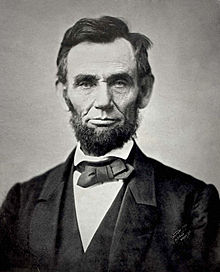
With my cell phone causing me problems yesterday, I found myself in that unfathomable situation where without company or reading material I would be stuck on the train with nothing to do but travel.  So I went to the newsstand and did something I haven’t done in quite some time.  I bought a magazine.  The magazine I chose was the most recent edition of Newsweek, the one with Abraham Lincoln on the cover.  Reading the article made me think long and hard about the concept of civil war in these United States, what would cause it, and what the potential impact would be on our society.

By all accounts Abraham Lincoln was a great man.  He dared to change one of the most significant and indecent aspects of American society.  As somewhat of a news junkie I follow current events to the extent that I am able to form opinions and see patterns according to my own personal opinion.  With this in mind I realize that on some level Lincoln may have been fortunate to be the right person at the right time, but with such a large segment of the population opposed to his stance that it caused enormous consequences both nationally and for him personally, Lincoln deserves his  positive legacy.

But what if he were alive today?  With today’s perception of what is a Democrat and Republican, it may come of a shock to the unknowing that Lincoln was a Republican president.  How would he have been perceived by his party and opponents today?  I understand that times change so the comparisons are questionable, but to me it brought a glaring issue to the forefront.  The issue I am speaking of is the growing schism between the right and the left that leads to the use of the words Conservative and Liberal as a means to insult people.  The danger in this schism is that when people are divided to this extent the people that come to forefront are often those whose agenda challenges peoples’ freedom.  When that happens true evil rises accompanied by war and persecution.

Pope John Paul II was a great man.  He fought against Nazi oppression, helped Jewish friends as a young man in Poland, helped bring down the Soviet empire, and lead the Catholic Church with goodness and thoughtfulness.  Pope John Paul II was unquestionably a Conservative.

Steven Spielberg has directed films about the Holocaust and Slavery, given enormous amounts of money to charity, and used his voice to champion causes that support human rights everywhere.  As someone who generally supports the Democratic Party and based on his public stances on social issues Steven Spielberg would most likely be categorized by most as a Liberal.

In today’s world when spoken of by the opposition, both Liberals and Conservatives are evil and the cause of all our problems.  Just ask Rush Limbaugh or Janeane Garofalo.  I am sure they will tell you how evil Liberals and Conservatives are respectively.  If you need confirmation I am sure you can get it from the likes of Ann Coulter or Michael Moore.  Just ask these people, people who naturally have no personal agenda (please recognize the sarcasm), and I am sure they will show you, in detail how Conservatives and Liberals are destroying our society.   In fact, let us pretend Lincoln were alive today.  We might have Rush Limbaugh show us what a traitor he is to his Conservative base and a danger to the future of all good people of the good ole US of A.  If that doesn’t work for you we can have Michael Moore dig up some dirt on him and show us how he is using the hardships of a segment of our society to push his Republican agenda and unjustly seize control of the government.  I’m sure the word conspiracy will be in there somewhere as well.  Whatever the case may be, today that Liberal thinking Conservative would be seen as one evil war-mongering killer of the fabric of American society.

In today’s world, a world where anyone who is not like-minded is an evil Conservative or an evil Liberal, the only place to be is smack in the middle.   But be careful.  If you’re a Conservative who believes in a woman’s right to choose or a Liberal who believes in a tough stance on Foreign policy you’ll be thrown right back into the category of evil.  But fret not.  The great Abraham Lincoln will most likely be standing right beside you.


“Never Again”: More than a slogan

When I was a 14 year old boy my parents took me and my sister on a vacation to Copenhagen, Denmark.  Part of the trip was a short hovercraft ride over to the small Swedish city of Malmo.  I remembered this trip because of how nice the people were, how good the food was, and how pretty the cities were.  So when I read reports of anti-Semitic attacks on the rise in Malmo, it saddens me, scares me, and angers me.  With an estimated 600 Jews living in Malmo, and a Muslim population of 6,000, the question that needs to be put out there is what is the motivation for the anti-Jewish sentiment?  In France, a nation of over 60 million people, the Muslim population is an estimated 6 million strong, with a Jewish population that has shrunk to under a half a million.  The situation in France has reached a point where Jews are being murdered by terrorists, people randomly attacked, and vandalism of Jewish institutions is on such a rise that the French police are finding it more and more difficult to provide any form of protection, assuming they wish to.  The same question needs to be asked here.  What is the reason for this anti-Jewish sentiment?

It is not fear.  It may be marketed as fear, but the numbers speak for themselves.  Is it political?  Is it a protest against Israeli policy towards the Palestinians?  No more so than the Nazis reason for murdering Jews was based on the so-called Jewish control of the banks.  Sheikh Mohammed Badie, the Supreme Guide of Egypt’s Muslim brotherhood said that the Jews   “spread corruption on earth, spilled the blood of believers and in their actions defile holy places, including their own”.

There may be political motivations in all these instances, but at best these political motivations are the use of hate in order to rally the mob and keep control.  But make no mistake, the hate is very real.  The attacks, the vandalism, and the anti-Jewish statements all have their origin in hatred of the Jewish people.  Sadly, these regimes and communities have such control and influence over their people that the average person who, in their heart does want a peaceful world, has no realistic voice.  As a Jew and a son of Holocaust survivors, I cannot in good conscience say “Never Again” in one breath and be quiet about this growing wave of danger in another. I haven’t even mentioned Iran, a nation that has made it quite clear its willingness to murder Jews in numbers comparable to the actions of Nazi Germany.

Many believe that both FDR and Churchill had enough information about the mechanics of the Nazi killing machine to stop the murder of the Jews long before the war was over.  Nevertheless, these 2 leaders were the most important people in putting an end to the horror, which they did upon the defeat of Germany.  And no one ever accused them of being complicit with the Nazis, rather focused on their strategy and not making Jewish lives a priority.  The point being, they may have not had the level of morality to put a true value on Jewish life, but they were the best we had, and they made the difference in the end.

So it is with this I make this plea to the electorate of nations such as England, Israel, and most immediately, the United States.  Continue to use your democratic rights to fight for your candidate.  Criticize, chastise, dig up dirt if that is your style, I don’t care.  But when then election is over support your democratically elected leader. You can fight to influence your president and hold him accountable, but don’t fight or obstruct him.   We can spend all day discussing and debating how much anyone who is not Jewish genuinely cares about the Jewish people, and we can easily take the discussion back to the days of FDR and Churchill.  But at the end of the day the reason some form of decency and Jewish life survived was because there was true focus on who the true enemy was.  And I have no hesitation when I say that the true enemy today is neither a Democratic or Republican nominee for President.  The true enemies, Muslim extremists, have their sights on democracy everywhere and ultimately will be the enemy of the people whose help we need the most.  At the end of the day, love or hate your leader, they may end up being our best shot at assuring that “Never Again” is not just an empty statement.


Yet Again, From the Ashes…..

In a day and age where the most popular stories tend to involve scandal, hate, and violence, I am happy to offer a positive story of renewal, hope, and the re-connection of a family.

For those of you who have read the book Jew Face, you will know of the story of my mother’s favorite childhood cousin David van Hasselt.  For those of you who have not yet read it,  when my mother, born Sipora Rodrigues-Lopes was 13 years old, her mother passed away of natural causes. With a father who was a young man and somewhat lost with the premature loss of his wife, and a younger brother in need of guidance and love, much of the weight of the world fell into Sipora’s lap.  The people who would provide love and support to the family would be critical to the household and in many ways would be the key to emotional survival.  One of the main people to provide this support to Sipora would be an energetic and personable young man, her cousin David van Hasselt.  It was during this important time in Sipora’s life that David would achieve that special status of favorite cousin.

With the brutal and vicious Nazi war machine occupying Holland in May of 1940, the future of the Jewish people quickly would become bleak.  The method used to eliminate the Jewish population and to instill terror and establish control however was gradual and methodical.  The first major activity against the Jewish people of Amsterdam would take place in February of 1941 when  the shooting of a Nazi official was made to look like the act of a Jewish male and would subsequently lead to the arrest of anywhere from 300-500 young Jewish men.  The men would all be deported to Mauthausen Concentration Camp in Austria where they would be murdered or made to work under the worst conditions until they died a horrific death.  One of the men was my mother Sipora’s cousin, David van Hasselt.  Although the memory of David would always live in Sipora’s heart, with his death and the subsequent Holocaust which took the lives of 104,000 Dutch Jews, an estimated 75% of the Dutch Jewish population, Sipora would be left with nothing but a memory of the cousin she loved so much.

Fast forward to April 2012 with the release of the book Jew Face, the book I had the great honor to write about my parents’ life primarily revolving around their experiences taking place from 1940-1945 in Nazi-occupied Holland.  In the beginning of October I received an email from a man in Holland named Ron van Hasselt.  Although in his own words there is some significant distance in the relationship to my mother and our family, he is nevertheless connected.   Ron, also an author of a book relating to experiences of his family during the Nazi’s occupation, has been active in finding family, be it close or distant.  His book, a Dutch language book entitled “De Oorlog Van Mijn Vader”, means “The war of my father”.  His website is in Dutch but with the use of Google translate can be read in English and found by going to the link http://www.deoorlogvanmijnvader.nl/.

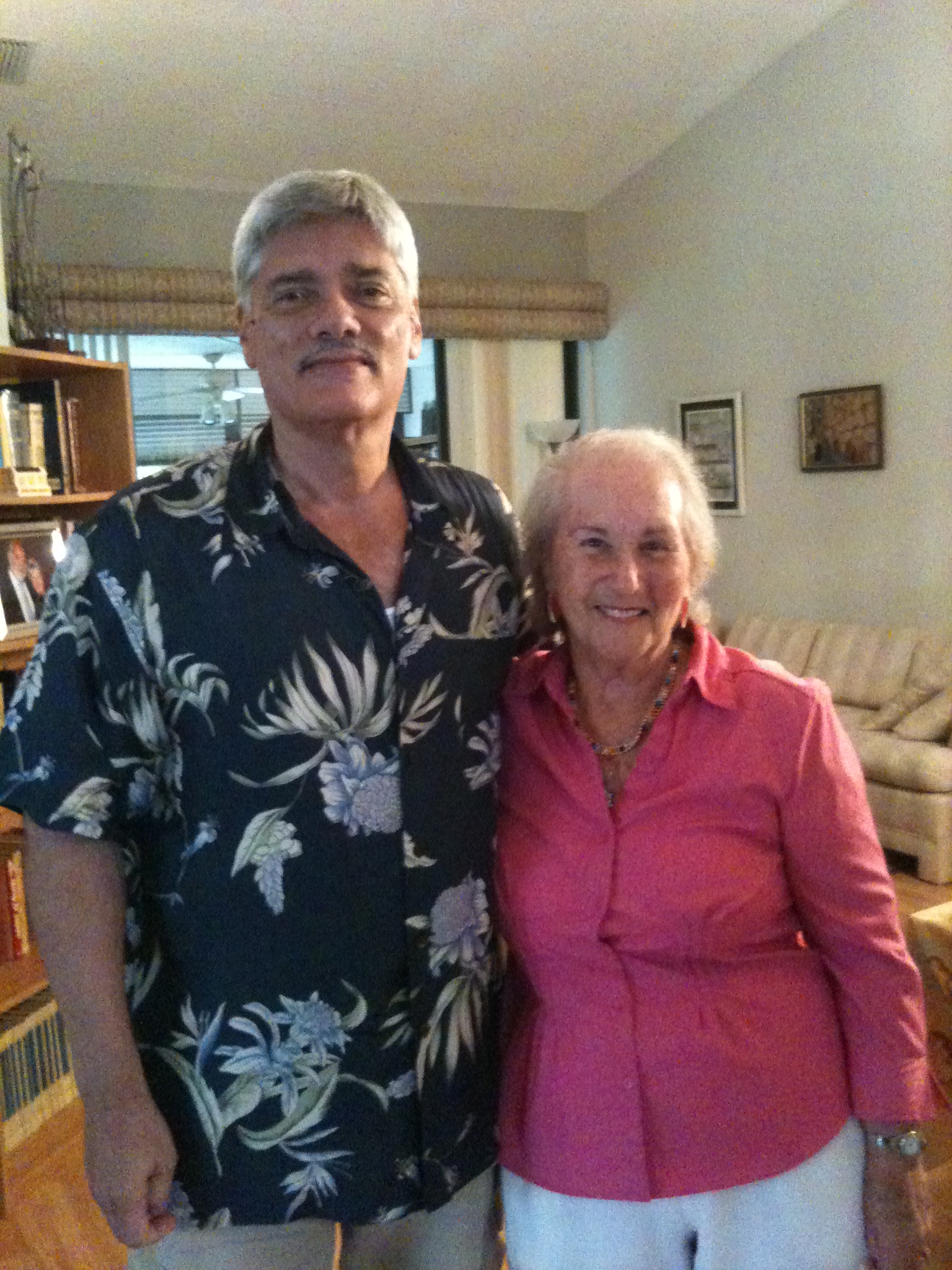
Ron, being the tremendous researcher that I have now begun to learn that he is, googled David van Hasselt, found my book Jew Face, and subsequently located both me and my mother.  He went on to discover her close proximity to his relative Vincent and forwarded him the information.  Who exactly is Vincent van Hasselt?  Vincent is the son of Edward van Hasselt, who was David van Hasselt’s brother and another one of my mother’s cousins.  All this leads us to the picture you see in this post.  It is my mother Sipora Groen, standing next to Vincent, the nephew of her favorite childhood cousin David van Hasselt this past Sunday after they met each other for the very first time.  Although the surviving family members lost contact after the war, through Ron van Hasselt’s successful efforts, and the writing of the book Jew Face, I am happy and proud to say that long-lost family members have begun what will hopefully be a meaningful and joyous reunion.  Of all the possible achievements I hoped for in writing the book, none has been more special than this one.   Not only has it bought joy to a family reunited, but it has helped keep alive the memory of my mother’s lost cousin.

Yet again, from the ashes, the family grows.


The following is an excerpt from the book Jew Face.  It is titled “A lost cousin” and tells the story of David van Hasselt:

A Lost Cousin

 After her mother died, five years prior to the occupation, Sipora would find solace in whatever support she could from close friends and family. Everyone meant well, and there were people who came by the house often, but between the tough economic times and the fact that people had their own families to attend to, it was difficult for most to come see her, her brother, and her father on any consistent basis.

Sipora was always well mannered and gracious and always showed the appropriate appreciation toward anyone who helped her or her family. Like anyone else, though, Sipora had her favorites. These were the people whose visits brought genuine joy. One such person was her cousin David van Hasselt.

David wore that special mantle of favorite cousin. He had been a regular visitor in their household for years and had every intention of coming at least as often, if not more, after the untimely passing of Sipora’s mother. Sipora loved his visits. He would make her laugh; he would talk with her about music, art, ice skating; and he would even help her with her schoolwork from time to time. Whenever he would visit, it would be the highlight of her day.

After her mother died, Sipora needed anything that made the day a little special. At the young age of thirteen, Sipora had household responsibilities thrust upon her most often given to women at least five years older. Her life at a young age was not easy. Her cousin David was a special friend.

David van Hasselt was a bright, funny, strong young man, who at the outbreak of war in Europe had made the decision to join the Dutch army. On May 15, five days after the Germans attacked,the war was over in Holland. With the Nazis steamrolling through Holland and Belgium and bearing down on France, the Allies planned a defensive assault on Dunkirk, France. If nothing else, it was an attempt to slow down, if not halt, the German juggernaut. So it was on May 24, 1940, fourteen days after the war had begun and nine days after the war was over in Holland, that David van Hasselt was amongst the Allied troops confronting the Nazis in what would be a failed attempt at any sort of conquest.

Although the mission at Dunkirk was a failure, a total disaster was averted when Nazi leadership chose to delay any counterattack for three days in an effort to maintain solid control of its forces. This gave most of the Allied forces time to regroup and evacuate to England.

David, however, chose to go back to his hometown of Amsterdam rather than follow the other soldiers to England. Having all his family and friends in Holland, David felt that the only correct choice for him would be to go back home and be with the people he cared about.

Meanwhile, the Nazi occupiers of Holland, who until now had taken no action against the Jewish population, were getting geared up to make their first raid against what they saw as this inferior race. They planned to hit in the heart of the Jewish community of Amsterdam, sending troops to Rapenburg Street in the center of the Jewish ghetto. Their orders were to pick up between 300 and 500 young, healthy Jewish men for deportation. They wanted to create immediate fear and doubt in those who were most able or likely to oppose them in future attacks, while fabricating a claim of an imposing threat.

David was not a resident of the Jewish ghetto, but a number of people that he was close to did indeed live there. One such person was his sweetheart, who he would visit on a regular basis. The past few weeks had been better times for David than any he had seen since before the war. He had enjoyed the time with his parents, caught up with his best friends, and now was on his way to Rapenburg Street to see his girl. They had been discussing their plans for the future, and although things were not looking very good for Europe as a whole, life had to go on, and being with her was the only way David wanted it to be at this time. They had considered going to England together in the assumption that things on the Continent were going to get worse before they would get better. They had discussed it many times and hoped that if it was necessary, they would be able to leave together.

On February 22, 1941, as David was walking on Rapenburg Street, he heard what sounded like screaming and fighting. When he turned the corner, he saw a mob of what looked like a thousand people; the majority was the Grune Polizei (Green Police). He knew he could do nothing and was considering turning around or hiding. But it was too late. They had already seen him.

Sipora’s favorite cousin was one of those taken away to Mauthausen in the raid of February 1941. David did not make it out, and would spend the next 7 months in the concentration camp before a report came back saying that he had died. When Sipora’s uncle learned of his son’s demise, he knew he needed to let his daughter know about her brother’s fate. However, being that his wife was no longer with him, he would have to tell her alone. This was something he could not do. He needed the help of someone close to him, and he needed it to be a woman. So he asked Sipora to help him. Sipora, at the age of nineteen, was already experiencing more death than most people would by that age. The lessons she learned at a young age would help see her through even more difficult times and teach her in many ways how to transfer that strength to the people close to her. However, as the war broke out, the first feeling for her, as it was for so many, was terrifying despair. And to have to break the news of the death of someone she loved so much to another relative she was so close with was in itself a horror she had not yet experienced. Especially considering the circumstances, or at least as much as she knew about the circumstances surrounding his death.

David van Hasselt: Murdered September 16, 1941, Mauthausen.