
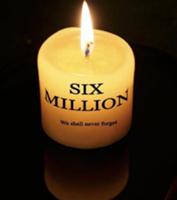
As we commemorate International Holocaust Remembrance Day, we sadly find Holocaust awareness moving in the wrong direction. The argument can certainly be made that more people today know the terms Holocaust, Nazi, and the name Hitler than at any time in history. But knowing a term or a name does not make someone truly aware. Awareness comes from knowledge and understanding—understanding how devastating the evil manifested in the Holocaust truly was, and the impact it continues to have on the generations that followed.
As has been the case throughout history, we live in a world filled with both good people and bad people. Evil is not exclusive to any specific era; it has always existed. However, there have been moments when evil reached an entirely different level. Quests for power within nations, or wars driven by conquest, occur in every generation in one form or another. What sets the Holocaust apart from every other event in history is that never before had evil been so successful in wiping out so many people from a single group. Add to that the fact that this is being written by the son of two people who lived through that horrific time, underscoring just how recent it was, and the importance of recounting this story today becomes as vital as ever.
As many of you may or may not know, I am a strong believer in people staying in their lane. I say this because I do not want what I am about to say to be misconstrued as political, nor do I want it to come across as an attack on—or endorsement of—the behavior of any individual or group. That is not my lane. My lane is Holocaust education and awareness, rooted in the story of my family, and more specifically, the story of my Uncle Bram and his violin. I am not here to tell anyone what to think or what to say. My hope is simply that by sharing what I know, people will be enlightened to think and speak in ways that promote tolerance and love over bigotry and hate.
Rising antisemitism is, naturally, of grave concern to us all. Ideally, I would like to never give up hope that it will one day disappear, however unlikely that may be. More urgently, however, is the responsibility we all share to ensure it never spirals into anything even remotely resembling what took place beginning in 1933. This brings me to the issue I feel compelled to address: the casual invoking of the term Nazi and the name Hitler. As I noted earlier, aside from addressing direct threats to Israel and the Jewish people, I publicly stay away from anything remotely political. And since I have heard people across the entire political spectrum misuse these terms, I am not speaking to any one group or individual. Instead, I want to explain why this behavior is not merely offensive—it is extremely dangerous.
Long before I wrote the book Jew Face, and long before I began speaking publicly, I remember walking as a teenage boy in London, where I attended a Jewish day school, trying to comprehend what it must have been like to live during the Holocaust. I was no older than seventeen when, at one point, seeing a clear, unobstructed path before me, I closed my eyes and tried to imagine what it would be like to suddenly lose between 50 and 90 percent of everyone I knew and loved. When I opened my eyes, I felt devastation unlike anything I had ever experienced—though it was not grounded in reality. For nearly every Jew in Europe who survived, my parents included, that devastation was reality.
And that loss was not the result of a plague or natural causes. It was the result of the systematic murder of the Jewish people—a mass killing so deliberately designed to wipe us off the face of the earth that it is more accurately described as extermination. An extermination that led to the murder of six million Jews. This does not even begin to account for the years of living in constant fear, when every Jew in Europe was forced into hiding or compelled to alter their identity in the hope of avoiding detection. Nor does it fully capture the sadistic brutality inflicted upon the Jewish people, or the reality of concentration camps—places designed either for immediate death or for slow, torturous ones.
The Holocaust was real, devastating, and recent. Its impact is still felt by the Jewish people, individually and collectively, to this day. When comparisons are drawn to events that barely scratch the surface of this devastation, it is deeply offensive to all who were murdered or who suffered during that time.
The danger lies in normalization. What Hitler and the Nazi regime did was evil on such an enormous and catastrophic scale that invoking their names through casual comparisons risks bringing that evil to life in a way that almost normalizes it for those with hateful words or dangerous intentions. It must be understood that this was not just evil on a mass level—it was insanity on a mass level. If I believed in putting my head in the sand when confronted with danger or evil, I would not do the work I do. But that work comes with responsibility. And part of that responsibility is making it clear that the vast majority of people alive today have never witnessed anything even remotely resembling the suffering and horrors of the Holocaust.
Let that understanding guide how we remember this day—and how we honor those who perished.
Am Yisrael Chai
Never Again Is Now!
Like what you see? Feel free to share!
HELP25.org
 Holland's Heroes